
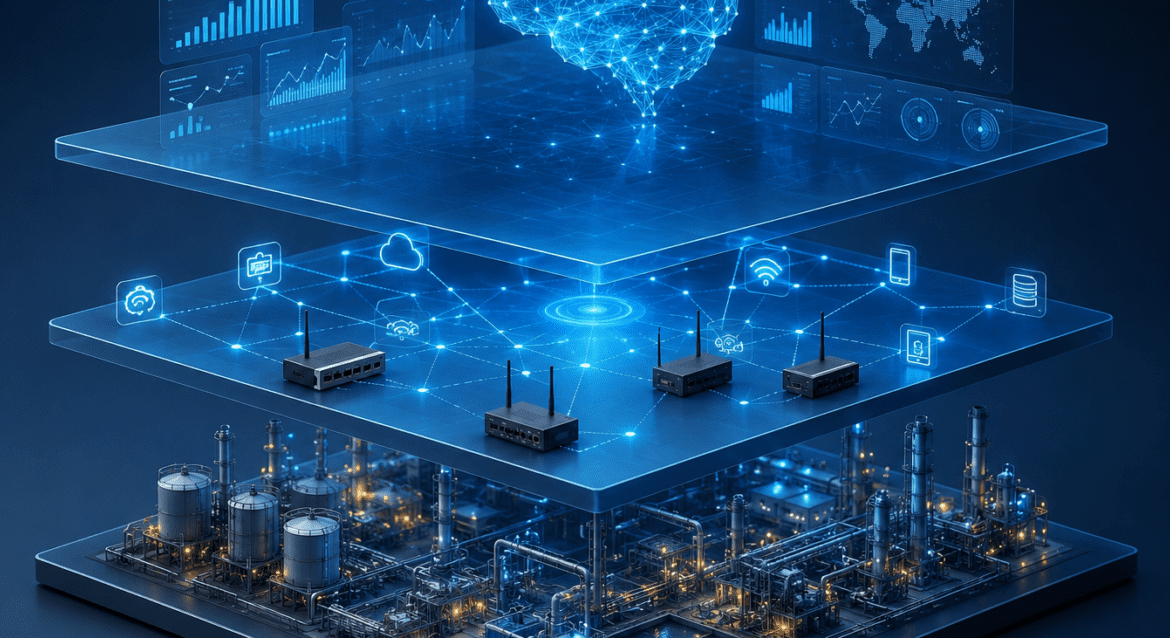
Most industrial operations have two monitoring layers already in place. SCADA handles real-time control and local visibility. IoT sensors extend that visibility to distributed assets. Both generate continuous streams of data. Neither, on its own, reliably answers the question that matters most: what is going to happen next, and what should we do about it?
Adding operational intelligence closed the gap between data and decision. You need to treat SCADA and IoT not as competing architectures but as complementary data sources feeding a single intelligence layer.
Why Industrial Monitoring Was Underdelivering
SCADA has earned its reputation. It is deterministic, reliable, and deeply embedded in safety-critical environments ranging from pipeline networks to water treatment facilities. Its historian databases capture decades of trend data. Its control loops respond in milliseconds. For the question “what is happening right now,” SCADA remains the gold standard.
The problem is that modern operations need more than a status update. They need a prediction.
SCADA historian data is not well-suited for machine learning. Scaling SCADA across multiple sites means heavy custom engineering and significant licensing costs. And while some vendors have added cloud connectors, the architecture is still largely on-premise and centralized.
IoT remote monitoring addresses some of those gaps. Cloud-native time-series databases, open API integrations, and scalable analytics make it far easier to monitor distributed assets across a global footprint. But IoT platforms, without an intelligence layer, produce more dashboards rather than better decisions. Operations teams end up managing alert fatigue from systems that detect problems but cannot prioritize or act on them.
The result is that most industrial organizations are rich in data and starved for insight. McKinsey’s 2025 State of AI research found that while 88% of organizations now use AI in some form, only 39% report enterprise-level impact on EBIT — a gap that traces directly to the missing intelligence and action layers above the data.
SCADA vs IoT: A Side-by-Side Comparison
Feature | SCADA | IoT Remote Monitoring |
| Architecture | Centralized, on-premise | Distributed, cloud and edge-based |
| Data Storage | Historian databases | Cloud-native time-series storage |
| Analytics | Historical trend analysis | Real-time, predictive, AI-driven |
| Scalability | Limited to specific sites | Global, multi-site, multi-asset |
| Integration | Proprietary vendor protocols | Open APIs and IoT standards |
| AI/ML Capabilities | Minimal | Embedded anomaly detection and predictive models |
What the Interscope AI Platform Does With the SCADA and IoT Stream
The Interscope AI Platform connects to existing SCADA systems via OPC-UA and Modbus, ingests IoT data streams via MQTT and standard APIs, and unifies both in a cloud-native operational intelligence layer. No rip-and-replace. No parallel infrastructure.
Once the streams are unified, Interscope applies continuous machine learning across the combined dataset. Anomaly detection identifies deviations from normal operating patterns within seconds. Predictive maintenance models use historical and live data to forecast failures before they cause downtime. Cross-fleet analysis compares performance across all connected assets to surface inefficiencies that would be invisible in any single-site view.
The shift is from static dashboards to ranked, actionable intelligence. Instead of knowing that a pump is running within spec, you know that it is likely to fail within three weeks, that a comparable unit at another site failed with the same signature six months ago, and that scheduling a part replacement now will cost a fraction of an emergency repair.
Where JERA AI Agents Drive the Response
Knowing a failure is coming is only half the value. The other half is what happens next.
JERA AI Agents read the intelligence Interscope surfaces and execute the response within boundaries the operations team defines. In a manufacturing environment, JERA can open a maintenance work order in the CMMS, notify the relevant technician, adjust the production schedule to reduce load on the flagging asset, and confirm completion when the work is done.
Operators set the rules. JERA handles the execution. The operations team focuses on exceptions rather than administration.
JERA also supports field technicians directly. In distributed operations where domain expertise is spread thin, technicians can ask JERA questions in plain language and receive context-specific guidance drawn from the asset’s actual history, its maintenance records, and its current sensor state.
Three Outcomes That Move First
Organizations that connect SCADA and IoT into the Interscope intelligence layer typically see movement in three areas within the first 90 days:
- Unplanned downtime reduction. Predictive alerts surface before failures propagate. Maintenance crews arrive with the right parts because Interscope identified the likely failure mode in advance.
- Alert rationalization. The volume of nuisance alarms drops sharply when machine learning replaces static threshold rules. Teams stop chasing false positives.
- Cross-site visibility. Performance comparisons across facilities reveal which sites are underperforming and why, making capital allocation decisions faster and more defensible.
What This Looks Like for Multi-Site Operations
The value of a unified intelligence layer compounds at scale. A manufacturer with plants in three countries can compare OEE across facilities in real time. A logistics operator can correlate asset health data from a mixed fleet of owned and leased vehicles. An energy company can monitor compressor stations across hundreds of miles of pipeline from a single interface.
SCADA stays in place at each site. IoT extends the reach to assets SCADA does not cover. For operations with remote or low-bandwidth locations, edge AI for operational intelligence processes decisions locally when cloud roundtrips are impractical. Interscope makes sense of the whole picture. JERA acts where human intervention would otherwise be required.

The Bottom Line
SCADA and IoT are not competitors. They are the two data layers that most industrial operations already have. The missing piece is a continuous intelligence layer that reads both, surfaces what matters, and closes the loop with action.
That is what Interscope and JERA deliver together. The result is not a smarter monitoring system. It is an operational capability that learns, prioritizes, and acts, while keeping the experienced team in control of what matters most. As McKinsey’s operations research documented in 2025, the industrial organizations that pulled ahead were those that connected the data-to-action loop — not just the data-to-dashboard one. For a deeper look at the business case for industrial operational intelligence, including how to quantify the ROI before committing to full deployment, that analysis is worth reading alongside this one.
Frequently Asked Questions (FAQ)
1. If SCADA already handles our monitoring, why add an AI layer?
SCADA answers the question “what is happening now.” Interscope answers the question “what is going to happen next, and what should we do about it.” SCADA was never designed for predictive analytics or cross-fleet comparison. The intelligence layer does not replace SCADA. It uses SCADA data as one of its inputs and makes that investment more valuable.
2. What does JERA actually do in a manufacturing environment?
JERA reads the alerts and recommendations Interscope generates and executes defined responses. In manufacturing, that typically means opening work orders in the CMMS, adjusting production schedules to reduce load on a flagging asset, notifying the right technician, and confirming task completion. Operators define the boundaries. JERA handles the execution within those boundaries.
3. Will connecting Interscope to our SCADA system disrupt our existing operations?
No. Interscope connects via standard industrial protocols including OPC-UA and Modbus. It reads your SCADA data without writing to it. Your control environment stays intact. The integration is additive, not disruptive.
4. How does Interscope handle the difference between SCADA historian data and cloud IoT streams?
Interscope normalizes both into a unified time-series model. SCADA historian data provides the long baseline for pattern recognition. IoT streams provide real-time context. The combination is what makes predictive models more accurate than either source could support independently.
5. How quickly can we see measurable results?
Bridgera designed the 90-Day Proof of Value to produce demonstrated outcomes before any commitment to full-scale deployment. Most organizations see their first predictive alerts within 30 days of data connection. Quantified ROI from avoided downtime or reduced maintenance spend is typically visible by the end of the 90-day engagement.
About Bridgera
Operational Intelligence. Production-Ready AI.
Bridgera partners with operations-heavy enterprises to move AI beyond pilots and into real production systems. Through AI consulting, specialized talent, and scalable platforms like Interscope AI™, Bridgera embeds intelligence directly into the operational workflows that power the business.
