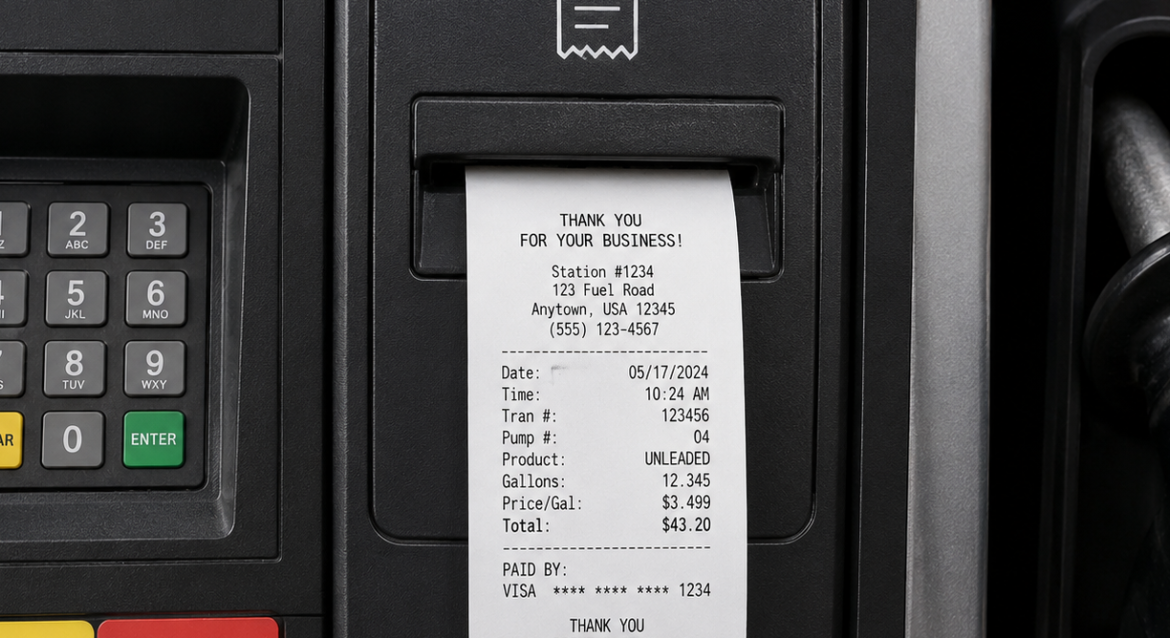
Printer failure at the gas pump is one of the most customer-visible failures in fuel retail. It is also one of the least monitored. When a customer finishes fueling and the receipt does not print, the transaction is not technically broken. The fuel was delivered. The payment processed. But the customer experience is broken, and what happens next costs the operation more than most managers realize. Predictive health monitoring for your forecourt thermal printers can vastly improve the customer experience.
If the printer fails, the customer has to go inside for a receipt. That means leaving their vehicle, waiting at the counter, and pulling a clerk off their work to print a duplicate. The customer who wanted to pay at the pump and stay in their car is now frustrated and making a mental note about the quality of the experience. The next time they pass this station, they may or may not stop.
At high-volume sites, printer failures at the pump are a recurring friction pattern that erodes the competitive advantage of the pay-at-pump service. And yet most fuel operations manage printer health the same way they manage every other peripheral failure: reactively, after the customer already knows about it.
Forecourt Printers Are an Overlooked Asset Class
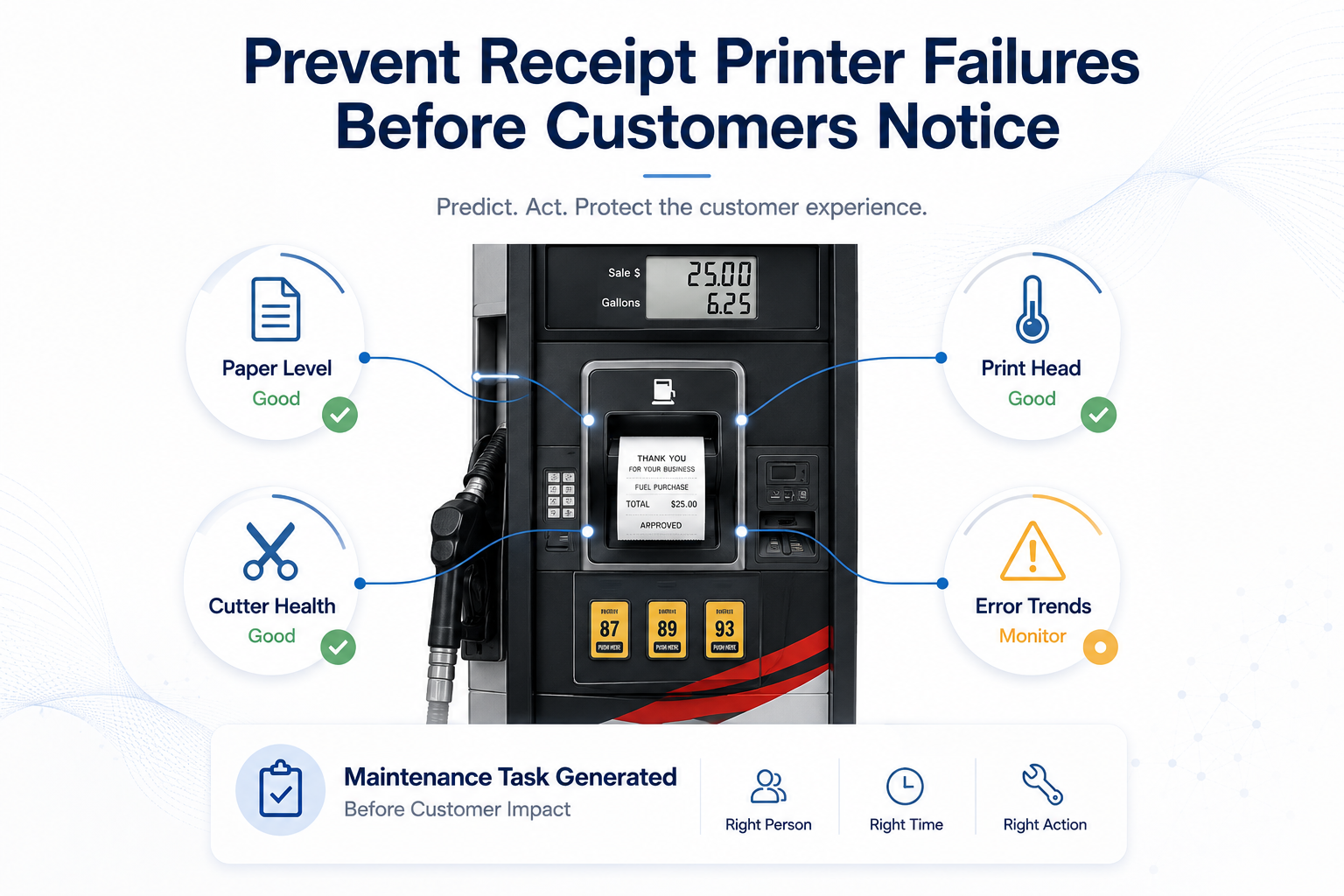
Just like with every other piece of peripheral equipment in the forecourt, printers generate health signals that no one systematically reads. The printer’s internal diagnostics generate stats on paper level, print head temperature, cutter mechanism status, and error event history. Unfortunately, that data is not making its way into any operational monitoring system in most fuel retail environments.
The result is a printer fleet managed entirely by customer complaint and staff observation. If the printer runs out of paper on a busy Saturday afternoon, it’s because no one checked the paper level that morning. The print head can begin to degrade, producing faint, smeared receipts, for days before it fails completely. Cutter mechanisms often jam on cold mornings, preventing a few busy customers from getting a receipt.
Each of these events is predictable. The paper level is a measurable quantity. The print head temperature is a trackable metric with known degradation signatures. Cutter mechanism stress shows up in current data long before it becomes a full mechanical failure. McKinsey’s research on analytics-based maintenance finds that predictive approaches can reduce maintenance costs 18–25% and lift equipment availability 5–15%. Forecourt printers are a direct application of that principle at the peripheral level.
It’s both the monitoring infrastructure and the training that are missing, not the data.
How the Interscope AI Platform Handles Printer Telemetry
The Interscope AI Platform reads printer health telemetry from the forecourt through the same edge gateway architecture that connects dispensers, ATGs, and pump controllers. Paper level, print head status, cutter mechanism state, error event history, and power state are all ingested continuously and aggregated into a health profile for each printer in the network.
Interscope tracks two categories of risk. The first is threshold-based: paper levels that are approaching a defined minimum, error event rates that are trending upward, temperature readings that are outside of normal operating range. The second is pattern-based: a print head that is beginning to show the early degradation signatures that precede a full failure, a cutter mechanism that is taking longer to complete its cycle, a pattern consistent with increasing mechanical stress.
When either category crosses a defined risk level, Interscope generates an alert. The alert is not “the printer is broken.” It is “this printer will be broken soon, at this location, and the intervention window is now.”
Where Bridgera AI Agents Drive the Response
Bridgera AI agents convert the Interscope AI platform’s printer health signal into operational tasks. When a threshold or pattern alert fires, AI Agent:
- Routes a pre-failure maintenance task to the site manager or store clerk assigned to printer maintenance. Printer service is typically an in-store responsibility, not a technician call.
- Specifies the action required: paper refill, print head cleaning, cutter inspection, or technician dispatch for a component approaching end-of-life.
- Logs the event and the resolution for maintenance history tracking.
The store manager receives a task before the customer experiences the failure. The clerk refills the paper before the roll runs out. The print head gets cleaned before the receipt quality degrades to the point of customer complaint. The maintenance intervention happens during a quiet period rather than during peak pump traffic.
Three Outcomes That Improve First
Operations that deploy predictive printer monitoring through the Interscope AI platform and AI agent typically see early improvement in three areas:
- Customer experience improvement. Printer failures that were previously discovered by frustrated customers at the pump are addressed before the customer interaction. Pay-at-pump delivers on its promise of convenience.
- Clerk workload reduction. Manual receipt printing and duplicate transaction handling at the inside counter decline as pump-level printer failures decrease. Staff time goe4s back to primary responsibilities.
- Printer component lifecycle extension. Predictive cleaning and maintenance prevents the accelerated wear that uncaught early-stage failures cause. Print heads and cutter mechanisms last longer when they are maintained before they degrade, not after.
McKinsey’s 2025 Race to Rewire Operations research identifies component lifecycle extension through predictive AI as one of the clearest pathways to measurable operational return.
What This Looks Like Across a Multi-Site Operation
For an operator managing a network of fuel sites, the printer fleet is large and distributed. A 20-site operation with four pumps per island and two printers per pump is managing 160 or more printer units. Manual monitoring of that fleet is not operationally feasible.
The Interscope AI platform monitors the full printer fleet continuously. Paper levels, print head status, and error event rates across all 160 units are visible in a single operational view. The Bridera AI agent orchestration agent routes maintenance tasks to the right person at the right site before any customer encounters a failed printer. The operations team works the exception queue rather than waiting for the complaint queue.
The Bottom Line
The forecourt thermal printer is a small piece of equipment with an outsized impact on the customer experience. Customers definitely notice when it fails. They do not notice when it works. The Interscope AI platform reads the printer health data continuously so failure remains hypothetical. The AI agent schedules a maintenance request before the customer faces the problem. So, the pay-at-pump process delivers what it promised. For a complete picture of how predictive monitoring applies across all fuel site equipment classes, see our guide to predictive maintenance in fuel retail and the comprehensive IoT fuel management overview.
Frequently Asked Questions (FAQ)
1. Do all forecourt printer models support the telemetry Interscope reads?
Most major forecourt printer manufacturers, including Epson, Axiohm, and Ithaca, expose health data through their controller interfaces. Bridgera’s initial data audit maps the specific telemetry available for each printer model in the network and configures the Interscope integration accordingly.
2. What does Bridgera AI agent actually do for printer maintenance workflows?
Our AI agent routes pre-failure maintenance tasks to the appropriate site-level staff member, typically the store manager or assigned maintenance clerk, with the specific action required identified. It distinguishes between tasks that site staff can handle (paper refill, head cleaning) and those that require a technician dispatch (component replacement), and routes accordingly.
3. Is printer monitoring worth the investment relative to the cost of a printer failure?
The direct cost of a printer failure — a duplicate receipt printed inside — is low. The indirect cost — a customer who cannot get a receipt at the pump, goes inside frustrated, and reconsiders their next visit — is harder to quantify but real at scale. At high-volume sites with many daily printer interactions, even a modest improvement in customer retention compounds significantly.
4. Can this system monitor printers across different pump generations and brands?
Yes. The Interscope AI platform uses edge gateways to read printer telemetry regardless of pump brand or generation. The platform can handle mixed fleets of printer hardware across different pump and printer manufacturers.
5. How quickly can predictive printer monitoring reduce reactive failure rates?
In most deployments, pre-failure intervention rate improvement is measurable within the first 90 days as Interscope begins identifying printers approaching threshold conditions. The reactive failure rate declines as preventive tasks replace reactive responses.
About Bridgera
Operational Intelligence. Production-Ready AI.
Bridgera partners with operations-heavy enterprises to move AI beyond pilots and into real production systems. Through AI consulting, specialized talent, and scalable platforms like Interscope AI™, Bridgera embeds intelligence directly into the operational workflows that power the business.