
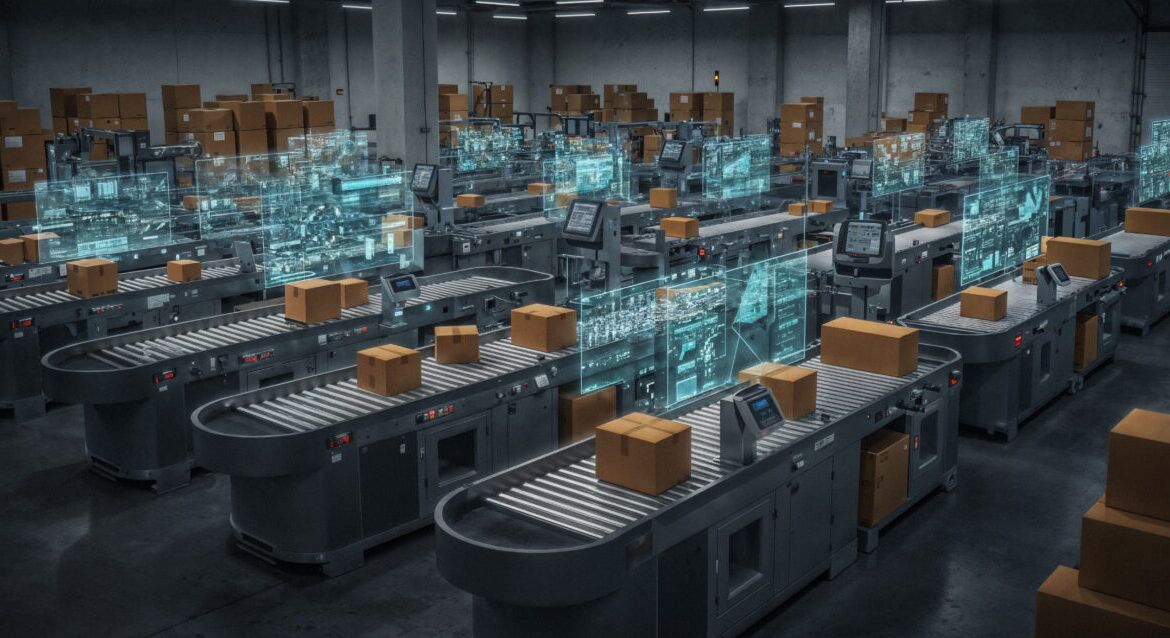
You don’t build a smart logistics ecosystem one truck, warehouse, or shipment at a time. Smart logistics become operational when the connections between assets and disparate systems start producing interconnected decisions. The first generation of logistics IoT delivered visibility into your assets: you tracked fleets and shipments, and warehouse, fleet, and shipment data appeared on a dashboard.
The next generation of logistics delivers something much different. With agentic AI, the data reads itself. Humans and AI agents work together to make decisions based on anticipatory patterns. In other words, your AI platform has identified a number of upcoming issues, from the mass of data generated by your IoT sensors and operational records.
An intelligent AI layer above your logistics stack, continuously monitoring and identifying potential friction points in your business. This is what a smart logistics ecosystem looks like in 2026.
What Smart Logistics Was Supposed to Deliver
The business case was always built around coordination: trucks, warehouses, customers, suppliers, each connected to one another through data. The logistics network should be running on condition data instead of based on phone calls and email chains.
The first part worked and asset visibility is largely accomplished through the use of IoT sensors, GPS, and other tools. Unfortunately, the second part stalled. Visibility on its own does not coordinate the network; it just tells the dispatcher what is happening. While that is really important, by itself, it does not change what happens next unless the dispatcher acts on some piece of data.
A smart logistics ecosystem requires more than visibility. It requires a layer that reads the network continuously and acts on what it sees. McKinsey’s Supply Chain Risk Pulse reports that 82% of supply chains were affected by tariffs in 2025, with visibility limited largely to tier-one suppliers. The same use case underlies much of the thinking about business intelligence in the logistics industry.
What the Interscope AI Platform Does for the Logistics Network
The Interscope AI platform reads the logistics data continuously. It pulls fleet telemetry, warehouse sensor data, dispatch records, customer schedules, and any other data needed to coordinate the network. The platform then normalizes different input and output formats from systems that were never designed to share information. This task is fundamental to building an operational intelligence layer.
Once all of the system data is ingested, the Interscope AI platform puts predictive models to work against the data from the logistics network and its specific patterns. The platform identifies:
- the patterns that predict late deliveries.
- the asset conditions that predict breakdowns.
- the warehouse patterns that predict stockouts.
The output is a continuous view of the logistics network, showing which routes are at risk, which assets need attention, and which warehouses are heading toward problems.
Where JERA AI Agents Coordinate the Action
A smart ecosystem requires action, not just analysis. The JERA AI agent layer is what closes the loop across the network.
When Interscope flags a condition, the JERA agent can:
- Reroute a shipment that is at risk of missing the customer window.
- Open a maintenance work order on an asset before the breakdown happens.
- Trigger a replenishment order when a warehouse pattern predicts a stockout.
Jera orchestrates all of the pieces that made the underlying work invisible. The dispatcher and driver receive a normal route adjustment, the maintenance team receives a new, but unremarkable work order, and the procurement team notes a regular parts delivery. The on-time delivery rate at the end of the quarter shows a steady increase.

Three Coordination Decisions That Now Happen on Time
When the AI layer is in place, three logistics coordination decisions move from after-the-fact to in-the-moment.
The first is route and load assignment. JERA matches asset condition to job requirements. A unit with a predicted maintenance window does not get sent on a long-haul route.
The second is warehouse and inventory coordination. The platform sees consumption patterns and supply lead times together. Replenishment happens before the stockout, not after.
The third is exception handling. When something goes wrong, JERA routes the exception to the right person with the supporting context. The decision happens in minutes, not hours. BCG’s closing the AI impact gap research traces the difference between AI leaders and laggards to focus, scaling, and workflow change. The same logic anchors the broader work of optimizing your supply chain with industrial IoT.
What Smart Logistics Looks Like at Scale
For a logistics operator running across multiple regions or serving multiple industries, the AI layer changes the operating model.
The corporate operations team gets a single view of network health. The patterns that emerge in one region before they appear in another become visible in time to act. The decisions about asset deployment, warehouse capacity, and customer commitments get made on real network data, not on regional anecdotes.
The site teams get the AI working for them locally. The corporate team gets visibility across the network. The orchestration is automatic.
The 90-Day Proof of Value
A smart logistics ecosystem does not arrive on a multi-year timeline. It arrives through a 90-day engagement on a focused area of the network.
Phase one is a data audit. We map what is being captured, what is usable, and which area carries the highest payback. Phase two is the proof of value. We deploy Interscope on the chosen area, apply models, and show real decisions on real network data. Phase three is scale. We extend coverage and light up JERA agents on the workflows that produced the result.
The 90 days proves the AI layer can coordinate the network on the team’s actual operating timeline before any large investment is committed.
The Bottom Line
Building a smart logistics ecosystem is no longer a connectivity project. It is an intelligence project. The Interscope AI platform reads the network. The JERA AI agents drive the routing, the maintenance, and the replenishment. The network runs more reliably because the system is doing the coordination the team was trying to do manually.
That is what a smart ecosystem looks like when the goal is reliable on-time delivery, not better visibility into the misses. The same operating principle drives the five ways AI can address logistics challenges we see most often.
Frequently Asked Questions (FAQ)
1. We already have visibility across our network. Why add the AI layer?
Visibility tells you what is happening. The AI layer reads the data continuously and drives what happens next. Without an action layer, coordination still depends on dispatchers and managers acting on what they see in time.
2. What does JERA actually do for the network?
JERA reroutes shipments, opens maintenance work orders, triggers replenishment, and routes exceptions to the right person with full context. The action lands in the systems the team already uses.
3. How does this work across multiple regions and modes?
The Interscope AI platform produces a single view across the network. The corporate team sees patterns across regions. The site teams see local actions. Both run on the same intelligence.
4. Do we need to replace our existing logistics platforms?
No. Interscope sits on top of the platforms you already have. The intelligence is added without replacing the underlying systems.
5. How fast can we see results?
Bridgera built the 90-day proof of value concept to deliver measurable network improvements on a live targeted area. You’ll see results within one quarter.
About Bridgera
Operational Intelligence. Production-Ready AI.
Bridgera partners with operations-heavy enterprises to move AI beyond pilots and into real production systems. Through AI consulting, specialized talent, and scalable platforms like Interscope AI™, Bridgera embeds intelligence directly into the operational workflows that power the business.
