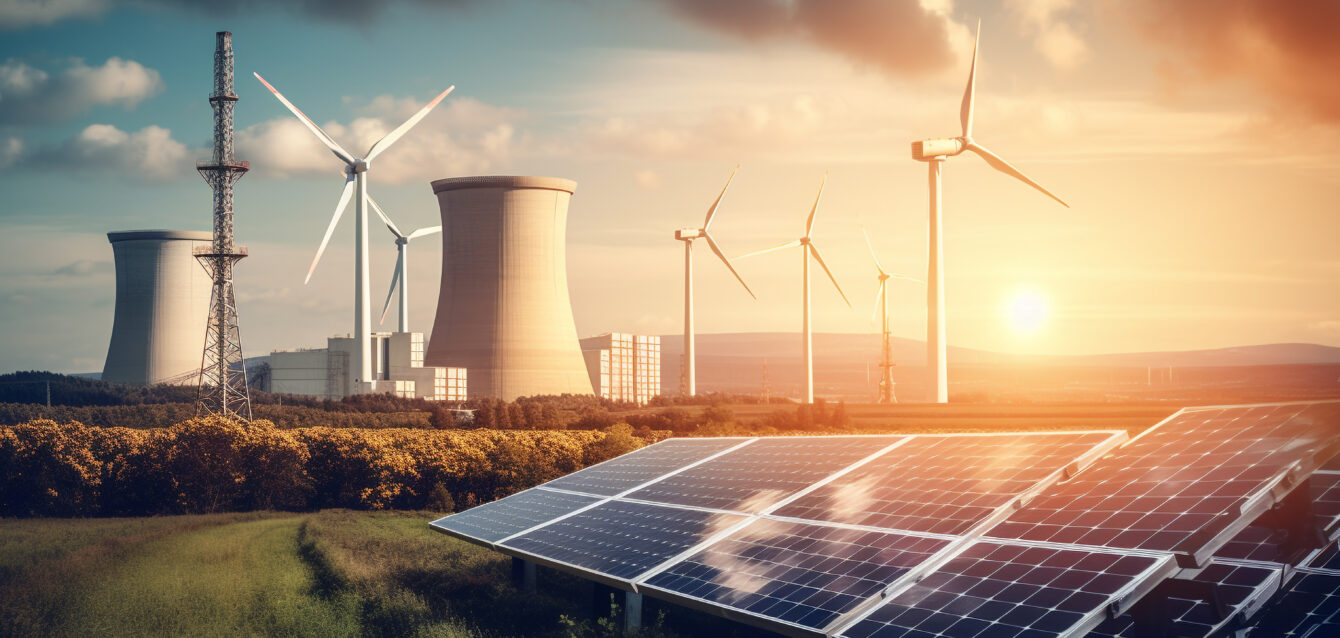
AI Addresses Energy Utility Complexity
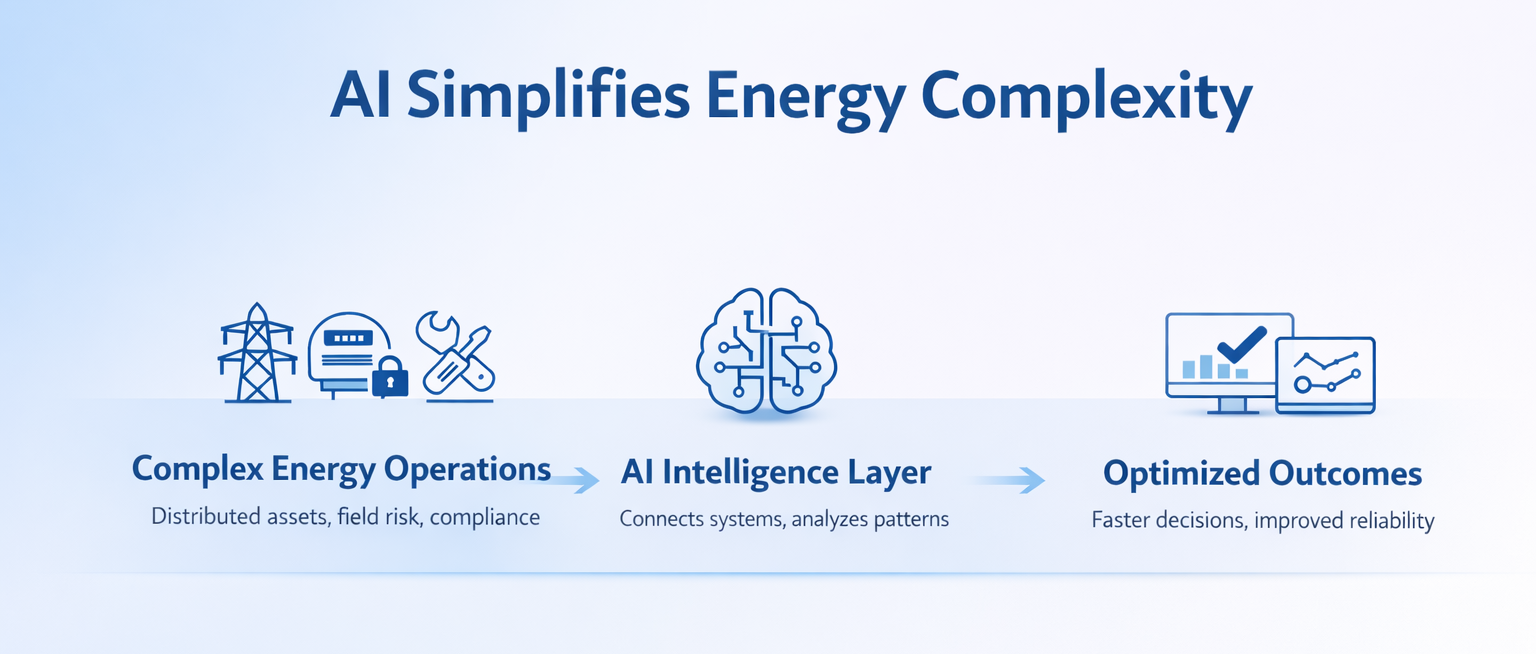
Like many service industries, the energy provider industry consists of several distinct operational domains, including:
- Power delivery across large distances
- Energy usage tracking and billing
- Installation, upgrading, and maintaining
- Security of hard assets like transformers and power stations
- Regulatory compliance
Energy delivery and management across large distances is the norm, not the exception. Drivers, trucks, and equipment are all subject to weather conditions, fatigue, and environmental and human dangers.
The Energy Provider’s Business
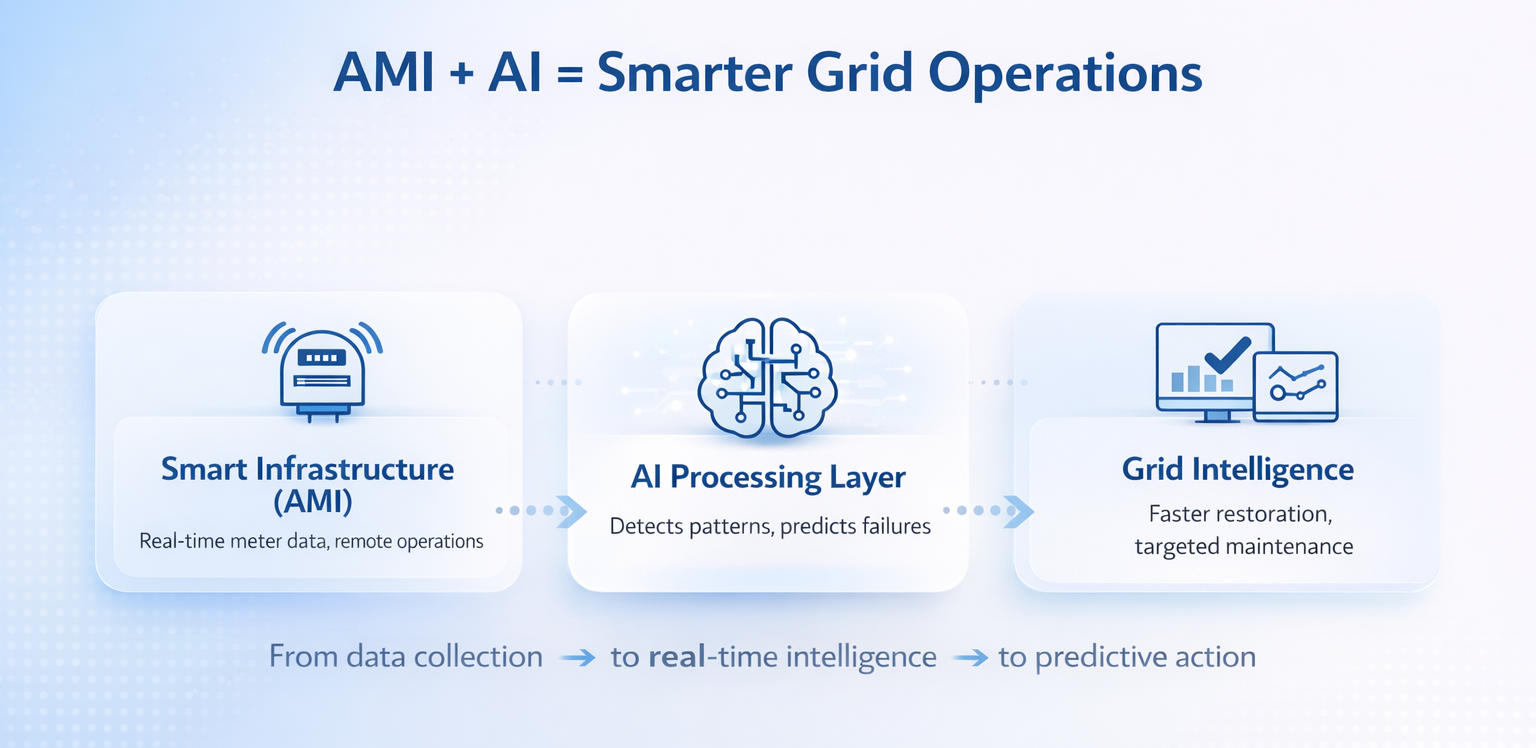
Many energy companies are in the process of rolling out Advanced Metering Infrastructure (AMI) which is intended to augment and eventually replace its predecessor, Automated Meter Reading (AMR), which moved meter reading from a wholly manual process to a drive-by, using wireless devices.
- Reduced Field Operations: By deploying AMI, companies can remotely read meters, eliminating the need for periodic manual readings and the associated costs of “truck rolls” and labor. This has high impact in geographically dispersed service territories where travel times can be significant.
- Remote Service Management: The company can fulfill service connection and disconnection requests remotely and on-demand. This reduces the time to fulfill orders from days to minutes and enhances employee safety by decreasing the need for field staff to enter properties.
Enhanced Outage and Asset Management
AMI acts as a critical component in improving grid reliability and optimizing long-term infrastructure investments.
- Faster Restoration: Smart meters can automatically transmit “last gasp” notifications when the power goes out, allowing the company to immediately pinpoint outage locations. When AMI is integrated with Outage Management Systems (OMS), the company can dispatch repair crews more precisely and identify “nested outages,” which are small pockets of power loss that might otherwise go undetected until after completion of a larger repair.
- Predictive Maintenance through Anomaly Detection: By applying analytics to meter data, current and historical, companies can monitor transformer loading and voltage levels to identify equipment that is at risk of failure. Identifying these anomalies allows for condition-based maintenance, enabling the company to replace aging assets before they fail and cause unplanned outages.
The Data Foundation
IoT sensors, smart meters, and other hardware and software monitors generate large amounts of data. While much data is now being output in JSON format, there are still some systems that output data in other text-base formats. For example, SCADA data from an electric utility substation might look something like this:
Electric Utility (Substation Level)
| Timestamp | Device ID | Point Description | Value | Unit | Status |
| 2026-03-31 13:05:01 | SUB_042_BRK_1 | Breaker Position | 1 | Binary (Open/Closed) | Good |
| 2026-03-31 13:05:01 | SUB_042_XFMR_1 | Oil Temperature | 72.4 | °C | Normal |
| 2026-03-31 13:05:02 | SUB_042_BUS_A | Phase A Voltage | 13.15 | kV | Normal |
Sensors generate time-based data, a snapshot of system elements at any given second in time. Until recently, this type of data required human intervention to make sense of status and potential anomalies.
Outage Management Systems (OMS) generate JSON data when they detect outages. The data can look like this:
JSON
{
“outage_id”: “OUT-9921-X”,
“status”: “In_Progress”,
“cause”: “Equipment_Failure”,
“start_time”: “2026-03-31T12:45:00Z”,
“estimated_restoration”: “2026-03-31T15:00:00Z”,
“customers_affected”: 412,
“location”: {
“feeder_id”: “FDR_774”,
“coordinates”: [34.0522, -118.2437],
“address_cluster”: “Oak St & 5th Ave”
},
“crew_status”: “En_Route”
}
This data not only provides timing, but attempts to identify outage cause and location coordinates. When these types of systems were first implemented, they were game changers. AI takes it to another level.
By using exactly the same information, AI can find patterns in the data, identifying pre-event conditions across hundreds or thousands of events. These conditions can enable the AI to predict when specific equipment will be at risk of failure.
One major upside is that deploying an advanced AI solution does not require companies to “rip-and-replace” existing systems. For example, Bridgera deploys an operational intelligence layer that performs a variety of proactive data analytics functions on existing systems and data. These analytics can assist the company in detecting theft, tampering, behavioral shifts, meter drift, unregistered meters, and more.
Where Providers Lose Money and Reliability
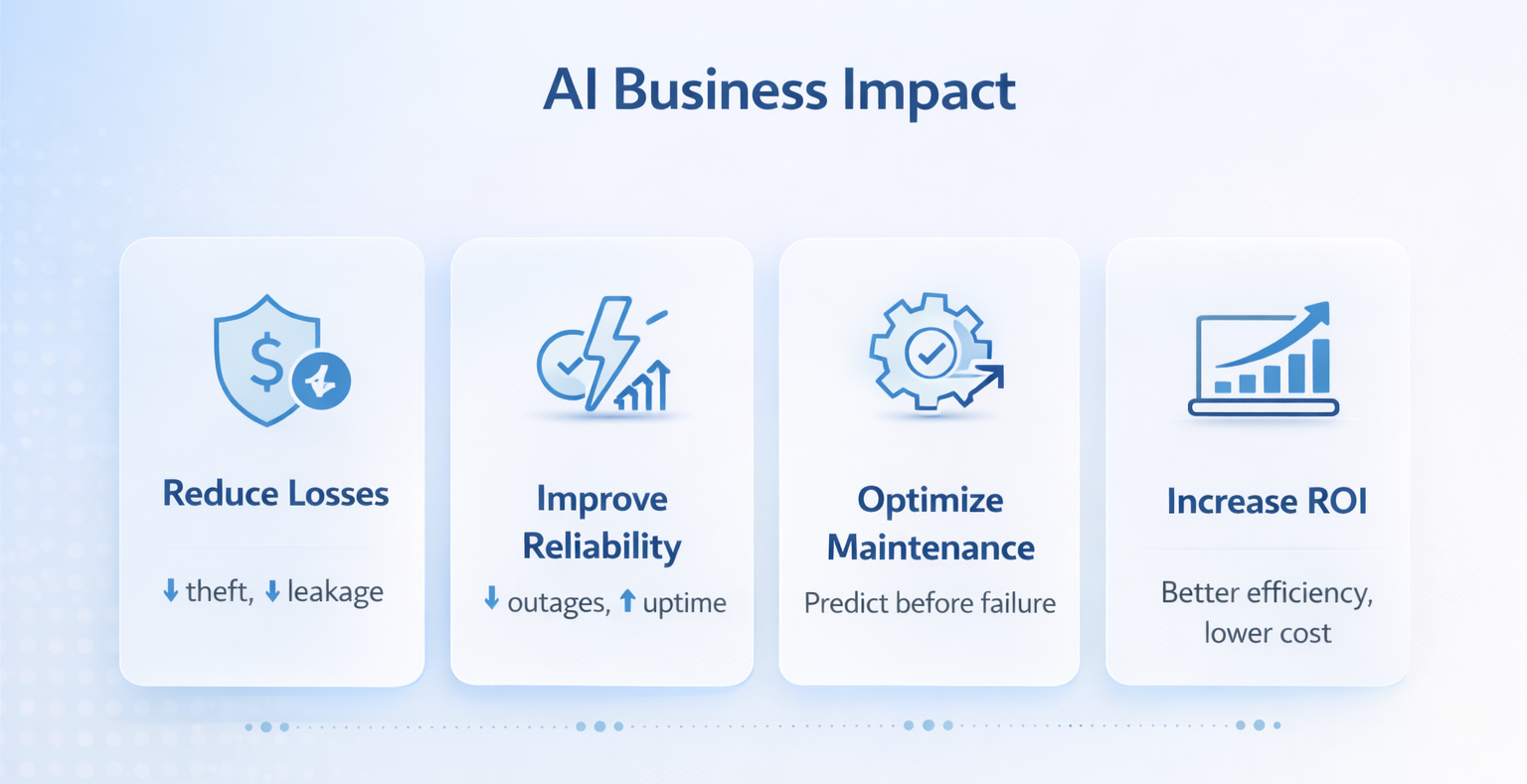
This is where energy providers lose money. Unidentified equipment degradation, outages, theft, meter drift, and billing leakage are just a few of the problems that eat away at profits and damage reputation.
AI-Powered Solutions
Three of the most powerful tools help energy companies across several critical functions:
Anomaly Detection
Anomaly detection refers to a number of techniques to identify non-technical losses, including electricity theft, meter tampering, and billing inaccuracies. Automating data analytics to proactively detect those types of problems can reduce financial leakage and to improve cost recovery. Systems can trigger real-time alerts for specific anomalies, such as removal, meter inversion, or reverse power flow.
Edge AI is particularly powerful in this context, as AI agents can be deployed in devices and systems close to physical devices. The close proximity means that the AI can make decisions and communicate anomalies more quickly, thereby cutting down on physical driving and unnecessary trips.
Predictive Maintenance
Most companies in this space are already moving from schedule-based preventive maintenance to condition-based predictive maintenance. Sensors collect data, as shown earlier, about various devices, including temperature changes, voltage levels, transformer loading, or other conditions.
A Long Short-Term Memory (LSTM) model allows an AI to analyze data from these devices to learn long-term dependencies in sequential data. This makes the LSTM model effective for time-series forecasting. Applied to the kind of time-stamped sensor data shown in the SCADA example above, an LSTM model can detect when a transformer’s oil temperature trend is drifting toward failure.
So, the AI can identify changes in devices over time, and the company can replace aging assets before they fail and cause unplanned outages.
Revenue Protection & Billing Quality
A persistent problem in utility billing is due to the quality of meter readings and the number of estimated readings. Theft also triggers discrepancies in billing. With the move to AMI, the number of estimated readings generally drops: estimated meter readings occur when a meter is unavailable due to weather, location, pets, and so on.
The technician and the billing department will attempt to use historical usage patterns to bill the customer. However, this can lead to wildly inaccurate billing. By using AI to compare current readings against historical trends, companies can prevent revenue leakage from erroneous readings. Automated systems flag inflated bills or unusual bill amounts for manual review. This can help reduce customer disputes and maintain customer trust.
Business Impact of Automating
The business impact of deploying automated systems and reporting mechanisms, such as OMS, AMI, and AI, is substantial. Utilities and energy companies can achieve significant operational efficiencies with these tools. While the use of OMS and AMI systems, among others, can provide flexibility and remote monitoring capabilities, adding AI to the technology stack gives companies the ability to anticipate, predict, and act on data-driven decisions much more quickly, reducing costs and improving service.
According to a Deloitte position paper, implementation of “predictive maintenance increases productivity by 25%, reduces breakdowns by 70%, and lowers maintenance costs by 25%.” When you’re running tight margins, these kinds of savings can be significant net positives to your bottom line. Other independent research shows that organizations implementing AI-driven predictive maintenance achieve from 10:1 to 30:1 ROI ratios within 12-18 months.
According to Northeast Group research, in 2017, global electricity theft and non-technical losses topped $96 billion per year. Operational AI can use anomaly detection and predictive maintenance to reduce theft and non-technical losses through billing discrepancies.
Why AI Projects Fail and How to Avoid It
Too many companies get into the mode of “rip-and-replace,” which often benefits the vendor more than it does the customer. Many large projects simply fail before they are completed. Projects fail for a multitude of reasons: inertia, change in strategy, lack of resources, change in management sponsorship, the list goes on and on. According to a Pertama Partners report that synthesizes data from RAND, MIT Sloan, McKinsey, Deloitte, and Gartner, in addition to Pertama’s own tracking of thousands of enterprise AI initiatives, 80%+ of AI initiatives failed to deliver value.
Organizational and Leadership Failures
Organizational and leadership failures account for between 61% and 84% of all failures. The lack of clear success metrics, underinvestment, and a lack of C-suite sponsorship were the biggest drivers of failure.
On the other hand, the report found that companies that instituted clear pre-approval metrics, sustained sponsorship, and that treated projects as transformation, not just as “rip-and-replace” IT projects, showed clear success at the rates of 3:1 to 6:1 over those companies who failed to institute those approaches.
How Bridgera Operates
Bridgera starts with detailed problem definition. According to the RAND Corporation study in 2024, misunderstood problem definition is the number 1 root cause of project failure. Bridgera works with clients to understand and define a problem, then demonstrates a Proof of Value on that problem, instead of a canned pilot. That PoV can then be scaled across the organization, at whatever rate the client chooses. And, the operational AI intelligence layer works with a company’s existing systems and data. Companies can save themselves a lot of trouble by deploying an AI operational intelligence layer on top of their existing infrastructure.
Let the AI do the work of rationalizing both structured and unstructured data. Gartner predicts that 60% of AI projects that don’t address the issues of unstructured data will be abandoned. This is why Bridgera’s intelligence layer is so valuable: AI can build links between all available types of data (once processed) and learn patterns, without years-long data engineering projects.
An MIT report showed that internal builds of AI solutions succeed only one-third as often as those implemented by working with specialized vendors. Building partnerships with specialized vendors leads to successful implementations 67% of the time.
Conclusion
This post just barely scratches the surface of the challenges facing utilities and energy companies. Likewise, it only mentions a handful of the technological solutions available to reduce costs and inefficiencies and to provide more efficient and safe methods to streamline field operations. Bridgera deploys its Interscope AI platform to build the intelligence layer over your existing systems, specifically for companies in Energy and in Gas & Oil. You might be interested in finding out how close you are to deploying our platform and Jera agent by taking our AI Readiness Assessment.
Bridgera also offers a free 15-minute discussion with its SVP of Engineering to discuss the specific issues your energy company is facing. No selling, just straight talk. You can schedule a call by clicking here.
Frequently Asked Questions (FAQ)
1. What is the difference between AMR and AMI, and why does it matter for AI analytics?
AMR (Automated Meter Reading) collects usage data on a drive-by schedule, typically once a month, while AMI (Advanced Metering Infrastructure) uses a fixed two-way communication network to collect interval data as frequently as every 15 minutes. The richer, more granular data from AMI gives AI models far more to work with, enabling real-time anomaly detection, consumption pattern analysis, and predictive insights that monthly snapshots simply can’t support.
2. How does an AI operational intelligence layer work with our existing utility systems without requiring a rip-and-replace?
An operational intelligence layer, like Interscope AI, sits on top of your current infrastructure, connecting to your existing metering head-ends, SCADA, MDMS, billing, and outage management systems via standard APIs and protocols. The layer applies AI analytics to the data those systems already generate.
3. What types of anomalies can AI detect in utility meter data, and how does that translate into recovered revenue?
AI can detect sudden consumption drops that suggest theft or meter bypass, meter drift and under-recording from aging equipment, billing-period inconsistencies, reverse power flow, and usage patterns on accounts flagged as inactive. All of these problems contribute to non-technical losses that cost the global utility industry an estimated $96 billion annually.
4. What is an LSTM model, and why is it particularly effective for predicting equipment failures in energy infrastructure?
LSTM (Long Short-Term Memory) is a type of neural network specifically designed for sequential, time-series data. It can “remember” patterns over extended time horizons, which makes it ideal for analyzing the kind of continuous sensor readings (temperature, voltage, pressure, loading) that utility equipment generates. This allows the model to distinguish between normal operational variation and a genuine degradation trend, predicting failures weeks or months before they occur so maintenance can be scheduled proactively rather than reactively.
5. How can a utility get started with AI-powered analytics without committing to a large-scale deployment upfront?
The most effective approach is to start with a focused Proof of Value project on a single, high-impact use case, for example, transformer health scoring, meter reading quality improvement, or gas leak risk modeling, using live data from an existing service territory. This demonstrates measurable results within weeks, establishes the integration patterns with your current systems, and builds the internal confidence needed to scale across additional asset classes and geographies.
About Bridgera
Operational Intelligence. Production-Ready AI.
Bridgera partners with operations-heavy enterprises to move AI beyond pilots and into real production systems. Through AI consulting, specialized talent, and scalable platforms like Interscope AI™, Bridgera embeds intelligence directly into the operational workflows that power the business.