
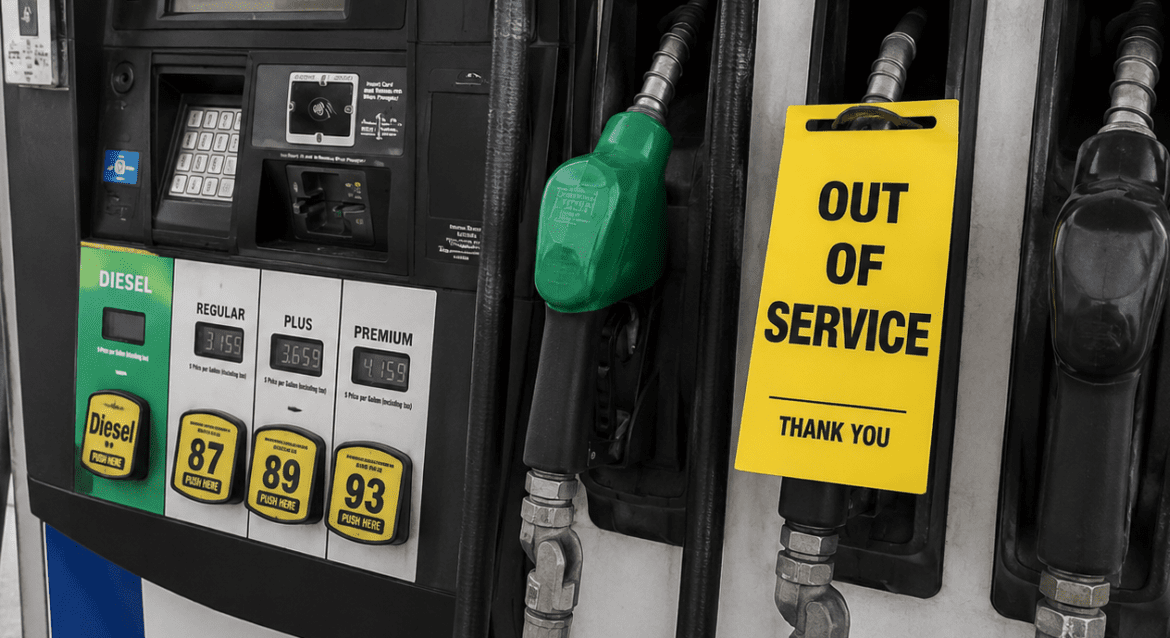
Every fuel retail operator knows the scene. A customer pulls up to a pump that shows as available. They swipe their card, wait for authorization, and nothing happens. The pump stays locked. The status on the screen means nothing to the customer so they get back in their car and drive off. Eventually the dispenser clears on its own or a staff member resets it manually and the next customer tries again. The term for what just happened is a ghost transaction. The pump received an authorization signal but never received a matching close signal from the POS.
The communication loop between the forecourt controller and the point-of-sale system broke down somewhere in the middle, and the pump stayed frozen in an authorized state while the sale never completed.
This is not a rare edge case. For operators running aging forecourt infrastructure or dealing with network instability inside their sites, ghost transactions are a recurring and measurable source of lost sales, staff escalations, and customer abandonment. The problem lives in the handshake between two systems that most operators treat as someone else’s problem: the forecourt controller and the POS.
Why the Forecourt Loop Is an Operations Problem, Not Just an IT Problem
The forecourt controller sits between the dispensers and the POS. Its job is to manage the authorization flow: receive a request from the POS, tell the pump to activate, monitor the fueling session, receive a completion signal, and close the transaction record. It operates in the same system as the Automatic Tank Gauge, sharing the site’s operational network and the same controller hardware. When that flow works, it is invisible. When it breaks, the dispenser remains in the “in progress” state, which the POS considers “pending.”
The failure can originate anywhere in that loop. Acknowledgement signals can be delayed by network latency between the controller and the POS. A firmware mismatch between the dispenser and the controller can cause the pump to send a signal that the controller doesn’t recognize. WiFi drops can interrupt the handshake and leave both systems waiting for a dropped response.
The result in every case is the same. A pump that should be ready for the next customer is locked. The next customer abandons the lane. Once a staff member eventually resets the dispenser, there is no record of what caused the issue or how long the dispenser had been stuck. And the revenue from the abandoned transaction does not show up anywhere in the day’s reporting. It’s an invisible loss.
The Gap That Makes Ghost Transactions Persistent
Traditional forecourt systems do not monitor the handshakes between systems in real time. The POS logs transaction attempts and the forecourt controller logs dispenser states. Neither system watches the communication pathway between them. And neither flags when that there are timeouts, dropped acknowledgments, or out-of-sequence signals along that pathway.
Of course, failures happen within the monitoring gap. An operator can have excellent POS and dispenser uptime, but still experience chronic ghost transactions caused by communication layer instability. Without automation, the only diagnostics are the ones that staff generate manually, like a reset log entry, a help desk ticket, or a customer complaint.
Those types of diagnostics describe symptoms. They do not identify the pattern that is producing the symptoms, the troublesome network segment or controller interface, or the impacted transaction volume.
What the Interscope AI Edge Intelligence Layer Does with the Forecourt Loop
The Interscope AI Platform deploys an edge intelligence layer inside the site that monitors the forecourt controller-to-POS communication pathway continuously. It does not replace the forecourt controller or the POS. Rather, it reads the signal flow between them.
The Interscope platform tracks every authorization attempt, acknowledgment signal, and close confirmation in the forecourt loop. It knows the expected timing for each step in the handshake sequence under normal site conditions. When an authorization signal is sent and the close confirmation does not arrive within the expected window, Interscope flags the transaction as a candidate ghost before the pump has been stuck long enough to affect the next customer.
Over time, the Interscope platform builds a behavioral profile of the forecourt loop at each site. It identifies which controller interfaces or network segments show elevated timeout rates, which time periods produce the most communication failures, and whether the pattern is drifting toward more frequent failures. That profile separates a real infrastructure problem from a one-off anomaly. The Interscope platform knows the difference automatically. The IT team does not have to review logs manually to find it.
Where JERA AI Agents Drive the Response
Flagging a stuck pump is the beginning of the response, not the end. The JERA AI Agent layer is what turns the platform’s readings on the forecourt loop into action. BCG research finds that AI agents already account for 17 percent of total AI value captured by enterprises in 2025, with that share projected to nearly double by 2028. The forecourt is exactly the kind of high-frequency, rules-bound operational environment where that you can see the true value of agentic AI.
When the Interscope platform identifies a transaction that has exceeded the expected close window, a JERA agent can:
- Send an immediate alert to the attendant queue with the pump number and the time elapsed since the authorization, so staff can act before the customer drives away.
- Initiate a controlled soft-reset sequence on the stuck pump through the forecourt controller interface, clearing the ghost transaction without requiring a staff member to physically interact with the dispenser.
- Log the event with the full communication trace for that session, so the IT team has a complete record for any diagnostic review.
When the platform identifies a degrading pattern across multiple sessions on the same controller interface or network segment, JERA escalates differently. Instead of a pump-level alert, the IT team receives a network-level flag: this interface is trending toward failure and the projected impact on transaction volume if left unaddressed.
The response to a single stuck pump is fast. The response to a pattern that predicts the next ten stuck pumps is proactive.
Three Failure Patterns That Edge Intelligence Catches Before They Compound
When the Interscope AI edge layer is reading the forecourt loop continuously, three categories of communication failure become visible early enough to prevent them from accumulating.
The first is intermittent latency. A network segment inside the site that adds 200 milliseconds to the acknowledgment window will not produce a ghost transaction on every attempt. But it will produce one often enough to generate a steady drip of abandoned customers and manual resets. The platform catches the latency pattern. The IT team gets a specific segment to address rather than a symptom to investigate.
The second is firmware-level mismatches. A dispenser that sends a close signal in a format the controller does not fully parse will produce timeouts on a subset of transactions, typically after a firmware update that was not fully validated. The platform catches the new pattern within hours of the update going live. The IT team can roll back or patch before the mismatch affects a full day of volume.
The third is cascading overload. During high-traffic periods, the forecourt controller queues more concurrent authorization requests than its network interface can process cleanly. The queue backs up. Timeouts accumulate. Ghost transactions spike. The platform sees the correlation between traffic volume and timeout rate and flags the infrastructure threshold before it becomes a peak-hour problem.
What This Looks Like for Multi-Site Operators
The ghost transaction problem scales with the number of sites and the age of the forecourt infrastructure. A single site with one problematic controller interface is a contained nuisance. A network of twenty sites, each with controller hardware that has been running for a decade, is an environment where the communication layer is degrading at different rates across dozens of locations simultaneously.
NACS research consistently documents that friction at the pump is among the primary drivers of customer abandonment and reduced return visits. A ghost transaction is one of the highest-friction events a customer can experience at a forecourt: they are already at the pump, card in hand, and the transaction fails visibly in front of them. Eliminating that event has a direct line to the customer experience metrics that drive fuel retail loyalty.
Multi-site operators using the Interscope AI platform get a ranked view of forecourt communication health across every location. Sites where the handshake is degrading rise to the top of the queue. Sites where a recent firmware update produced a new failure pattern are flagged the same day. The IT team works from a prioritized list rather than a reactive help desk queue.
The 90-Day Proof of Value
Deploying edge intelligence on the forecourt loop does not require replacing the POS, the forecourt controller, or the dispenser hardware. The Interscope AI edge layer integrates with the communication pathway that already exists.
Phase one is the data audit. We map the forecourt architecture at the target sites, identify the controller interfaces and network segments in the loop, and establish baseline timing profiles for the authorization handshake under normal operating conditions. Phase two is the proof of value. We deploy the Interscope AI platform on a defined set of sites, monitor the communication flow live, and surface real ghost transaction patterns on real equipment. Failure patterns that have been generating manual resets for months become visible within weeks. Phase three is scale. We can extend coverage to the full site network and light up the JERA agent workflows that handle both real-time pump alerts and predictive infrastructure flags.
Within 90 days you’ll see whether the edge intelligence layer improves the ghost transaction rate on real forecourt equipment before you need to consider an enterprise-wide investment.
The Bottom Line
The POS-to-pump sync gap is not a hardware failure or a software failure. It is a communication failure that happens in the space between two systems that were designed to operate independently. Neither system can see it. Neither system can fix it. The only way to manage it is to put an intelligence layer on the communication pathway itself.
That is what the Interscope AI edge layer does for the forecourt loop. It reads the handshake in real time, flags the failures that are already happening, and builds the pattern record that predicts the ones coming next. The JERA agents handle the immediate response and the escalation. The ghost transactions that were generating manual resets and abandoned customers become something the platform finds and addresses before the next car pulls up to the pump.
For IT teams managing aging forecourt infrastructure and for operations leaders measuring customer experience at the fuel island, that is the shift from reactive to predictive that makes the forecourt loop a manageable system rather than an unpredictable one.
Frequently Asked Questions (FAQ)
1. What exactly is a ghost transaction, and how does it happen?
A ghost transaction occurs when the pump receives an authorization signal from the forecourt controller but never receives the matching completion signal that closes the session. The pump stays locked in an “authorized” state while the POS treats the transaction as still in progress. The most common causes are network timeouts during the handshake, firmware mismatches between the dispenser and controller, and communication lag during high-traffic queuing. The pump does not know the transaction is stuck. Neither does the POS. Only a system monitoring the communication pathway between them can see it.
2. We already have a forecourt controller. Why isn’t that enough?
The forecourt controller manages the authorization flow but does not monitor the health of the communication pathway it depends on. It can tell you the current state of each pump. It cannot tell you that a specific network segment is producing elevated timeout rates, or that a pattern of failed handshakes is trending toward more frequent failures. Catching ghost transactions before they accumulate requires a layer that watches the signal flow continuously and understands what normal timing looks like. That is what the Interscope AI edge intelligence layer adds.
3. What does JERA actually do when a ghost transaction is detected?
JERA routes an immediate alert to the attendant queue with the pump number and elapsed time, initiates a controlled soft-reset through the forecourt controller interface, if the pump qualifies, and logs the full communication trace for that session. When a degrading pattern is detected across multiple sessions, JERA escalates a network-level flag to the IT team with the specific interface or segment that is trending toward failure. The response is proportionate to the scope of the problem.
4. Does this require replacing our existing POS or forecourt controller?
No. The Interscope AI edge layer integrates with the communication pathway between the systems already in place. It reads the signal flow without replacing the POS, the forecourt controller, or the dispenser hardware. The integration uses standard interfaces and does not require modifications to the existing systems on either side.
5. How quickly can we expect to see ghost transaction rates drop?
Most operators see the first measurable reduction in ghost transactions within the first 8 to 12 weeks of the proof-of-value engagement. The edge layer starts catching failures in real time, immediately. The predictive patterns, which allow the IT team to address infrastructure issues before they generate failures, typically become visible and actionable within four to six weeks as the platform builds its behavioral profile of the forecourt loop at each site.
About Bridgera
Operational Intelligence. Production-Ready AI.
Bridgera partners with operations-heavy enterprises to move AI beyond pilots and into real production systems. Through AI consulting, specialized talent, and scalable platforms like Interscope AI™, Bridgera embeds intelligence directly into the operational workflows that power the business.
